

Simone Worthing reflects on her time in Ukraine, the people she encountered, and her emotional and practical responses to what she saw in this beautiful country under siege.
Simone Worthing, editor of the Australian Salvos Magazine and her husband, Cliff, have spent the past four weeks travelling across Ukraine, supporting Salvation Army churches and community ministry in different regions of the country. Along the way, they have met Salvation Army workers, volunteers and people living through the conflict, an experience they have now witnessed first-hand.
Earlier, we brought you Simone’s report on an ‘In the Light’ event organised by young people at a local Salvation Army church. Here, in part one of her personal account, Simone reflects on her time in Ukraine, the people she encountered, and her emotional and practical responses to what she saw in this beautiful country under siege.
As we travel around central and western Ukraine and visit churches in these regions, our hearts are breaking at the impact of more than ten years of war1 in this beautiful country. And yet, as these brave, focused, faith-filled yet exhausted and grieving people show, there is hope, even if sometimes it struggles to find its place in the fear, destruction, death and trauma of war.
Despite the deep sadness of seeing so many lives impacted by more than a decade of war, we are humbled and inspired by this journey and the light that God is shining here through The Salvation Army.
Faces of Ukraine
‘I like coming here to the church,’ said Ludmila2. ‘I have nowhere else to go, nobody else to spend my time with. Here I meet new people, make new friends. God is here. The officers [Salvation Army ministers] are kind and compassionate. People care. It lifts my soul and gives me hope, and I really thought I had run out of hope.’
Ludmila, a middle-aged woman, has been living in very basic student accommodation in central Ukraine for four years. She fled her home, her neighbourhood (all she had known and worked for) when Russian troops stormed into her village in the now temporarily occupied territories of eastern Ukraine. She left the constant shelling, bombing of buildings, death, destruction and danger, fearing for her life and not knowing if she could ever return.


People find friendship and love at various church social groups and meal times for men and women.
Nadia is also from the temporarily occupied territories. ‘We had our own house, our own little garden that we had worked on and built for years. The Russians bombed and destroyed it. Now we have nothing. I don’t know if we will ever be able to return. I have run out of tears; I simply don’t know how to cry anymore.’
Nadia now works in a church in central Ukraine and assists with church programs as much as she can, including volunteering. ‘Being here in this supportive environment, worshipping God, knowing I am cared for and loved keeps me going and helps to heal my shattered heart. I am learning to laugh again.’
Marina also fled with her young family from eastern Ukraine, fearing for their lives when shooting erupted all around them as they drove on the only road out of town. ‘We saw terrible things, images I will never forget, but we made it out alive. And now here, we have found The Salvation Army – a miracle. My children are blossoming in the after-school program, they are smiling again. My husband and I can work to pay our bills, knowing our children are loved, looked after and safe. I thank the God I never knew existed until now.’
A senior member of a Salvation Army church in western Ukraine says that, perhaps strangely, she finds that she can feel moments of joy more deeply as the war continues, but it’s harder to find. ‘I need these moments, and look for them every day in flowers, sunshine, children. I find friendships at The Salvation Army, and I love to worship God here.’
Thousands of Internally Displaced Persons (IDPs) have fled the fighting in Eastern Ukraine to find safer locations within the country, although, as we are constantly reminded of, nowhere is completely safe. The influx of people has driven up rental and food prices in many of these small towns and villages, leaving many struggling to survive. People who do not receive the small government assistance provided to those who can prove their homes are unliveable due to attacks, often have to work multiple jobs to cover basic living costs. This stress and exhaustion add to their trauma and grief. The Salvation Army assists with vouchers for food and essentials, as well as pastoral and emotional support. The difference this help, and support makes is life changing.


Practical help is given through food distribution and voucher schemes.
Church programs include humanitarian aid through vouchers, Bible studies, women’s and men’s groups, the nation-wide after-school program, youth groups, choirs, free second-hand clothing, art therapy, music groups and safe places for coffee and conversation.
Working together
‘I thought my heart couldn’t take any more terrible news,’ shared a Salvation Army officer. ‘And then I heard on the news just a few seconds of a woman crying after hearing that her husband had been killed and my heart broke for her. How can she recover from this tragedy? I don’t know her, I have never been to her region, but we are all human, living through this together.’
Helping each other, whether it’s church members, volunteers, local communities or people generally from all over Ukraine, is a focus of The Salvation Army in this war-torn country. Church programs include humanitarian aid through vouchers, Bible studies, women’s and men’s groups, the nation-wide after-school program, youth groups, choirs, free second-hand clothing, art therapy, music groups and safe places for coffee and conversation.
The churches are second homes to many, who spend hours there each day for the fellowship, care, activity and family atmosphere. ‘I love the energy here and people coming and going,’ said one program participant. ‘In the women’s group we share our lives, our problems, our struggles and the officers help support us too. And my teenage children practically live here. They are so involved in everything, and I am so happy for them.’ The smile and relief on her tired face was heart-warming and palpable.
‘It’s very hard to run our children’s programmes here, but we will not give up,’ says a church officer in eastern Ukraine where citizens are subject to regular and devastating attacks. ‘Often, we have no power, no light, no water and days of shelling and attacks. But we keep working.’
In this same city, a woman whose son was killed in the war decided to donate his clothes, and many other things, to The Salvation Army’s second-hand clothing collection. She was familiar with the work of The Salvation Army in the area and said it was fitting, and brought great comfort, to know that her son’s belongings would be used to help others.
’I have no time to be tired,’ said another Salvation Army officer who serves at the church from morning until night, often with little time off. ‘When I think I am weary, all I need to do is see the smiles of the children, their faces lighting up with joy at the activities we prepare for them, and I get the energy and motivation to continue.’


There is a variety of programmes and activities for children and families.
The reality of war is present everywhere, even in the ‘safer’ cities – in people’s lives, families, city streets, village fields. The feeling of stress, tension and uncertainty is constant.
This same officer is supporting a woman whose husband and son were recently killed in the war. The officer made sure she changed some long-term plans so she could attend the funerals with the woman and support her. The woman was overwhelmed and thanked the officer for being someone she could really trust and rely on in life’s hardest moments.
Reality of war
The reality of war is present everywhere, even in the ‘safer’ cities – in people’s lives, families, city streets, village fields. The feeling of stress, tension and uncertainty is constant.
Some moments stand out.
One morning early in our visit to Ukraine, we were walking along the street in a south-western city with some Salvation Army officers, when sirens and a public address system announced the approach of military vehicles bringing coffins of the fallen to a nearby church for funerals. Activity up and down the entire street came to a standstill, including cars, buses and trams. Everyone was silent. Hundreds of people up and down the street got down on one knee as the convoy passed by. Many got out of their cars and did the same. People on trams stood up. Hands were on hearts. Young people, children, the elderly. And on loudspeakers, a message of thanks and respect was broadcast. This is done all over the country when farewelling the fallen. The convoy arrived at the church. Next to the church were hundreds of Ukrainian flags and photos of young men and women, a tribute to those from the city killed in war. It was so moving, so heartbreaking, so tragic.
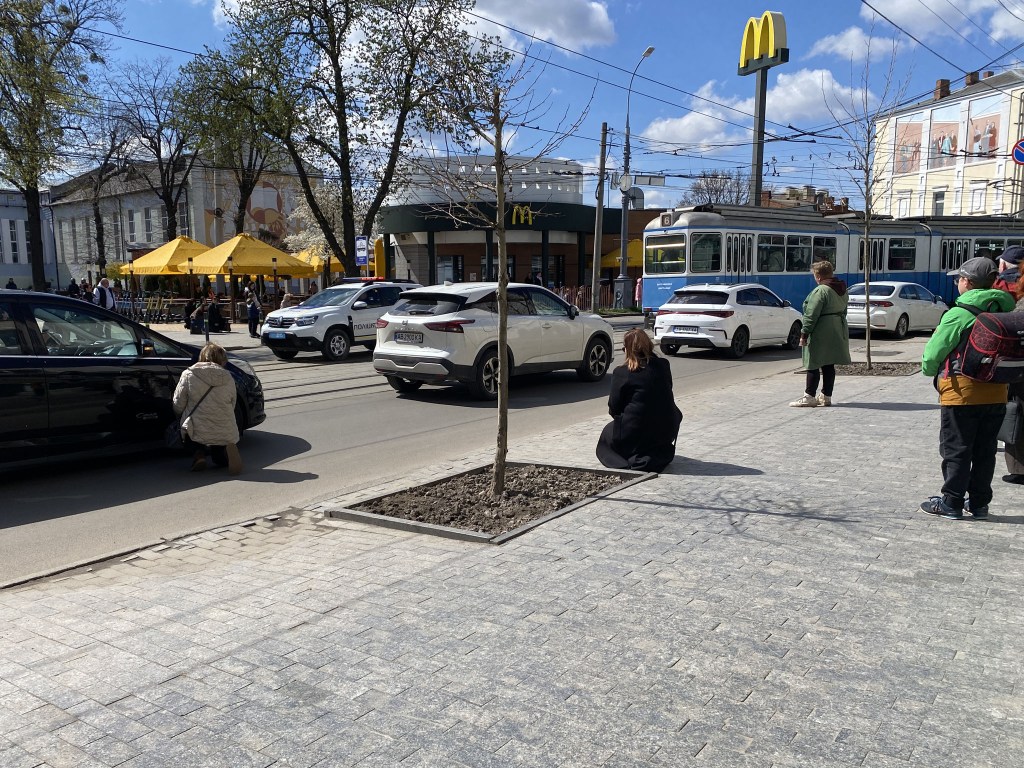
People in the streets pay respect for those who have died in the war
Hope dies last. We must hold onto hope. We need to find hope every day, even in the smallest thing, like music, or spring flowers, or the laughter of children. This will get us through this evening, tomorrow, and beyond.
Lighter moments
A women’s group gathered in a corps in central Ukraine. The first activity was making Ukrainian borscht (beetroot soup) and little meat pies. The church officer asked the women for their tips on how to improve the flavour and quality of the soup and the pies. As happens everywhere around the world, they discussed the importance of certain ingredients and methods – not always agreeing with each other – and settled on an overall approach. Their main goal seemed to be educating me on the specifics of Ukrainian borscht, as opposed to recipes for the soup in other countries!


Preparing borscht at a women’s group at a Salvation Army church
As we travelled with Salvation Army leaders through central western Ukraine, we noticed a couple of huge nests in the trees alongside the highway. The leaders explained, with obvious pride and delight, that these were nests belonging to the national bird of Ukraine – the stork. Over the past few years, these birds had not returned to Ukraine in spring, as was their usual custom. To Ukrainians they represent hope, freedom and happy times, so seeing them return has brought moments of joy and hope for better times to come soon.
In some Ukrainian supermarkets, customers are required to weigh their fruit and vegetables and attach the price sticker that the scales print out. In other supermarkets, scales are in the fruit department without stickers – the stickers come out from the scales at the checkout. I was confused in one supermarket, tried to weigh some mandarins, but couldn’t see any price stickers.
A young Ukrainian girl came up to me and held up her phone, showing me, the screen of Google Translate. The message, in English, read, ‘It’s okay, just take your things to the checkout and they will help you. Have a lovely day in our country, it’s good to see you here.’ She smiled and pointed the way to the checkouts before heading off with her friend. A simple gesture but it meant a lot.
Hope
One elderly lady, who has suffered so much and is constantly waiting for news of loved ones in temporarily occupied territories whom she can no longer contact, summed up the attitude of so many:
‘Hope dies last. We must hold onto hope. We need to find hope every day, even in the smallest thing, like music, or spring flowers, or the laughter of children. This will get us through this evening, tomorrow, and beyond.’
FOOTNOTES
1. In reality the war has been going on since 2014 when Russia annexed Crimea and conflict broke out in eastern Ukraine although the full-scale invasion began in February 2022.
2. All names have been changed
We would like to give thanks to everyone who shared their stories and looked after us so well in Ukraine and we continue to pray for an end to this conflict.

You must be logged in to post a comment.