

All the World spoke to children at Joytown who express how the learning community is helping them to realise their dreams and ambitions
The Salvation Army’s Joytown learning community is situated on the edge of Thika, where the red earth of central Kenya meets rows of pineapple fields and the restless flow of traffic from Nairobi. Thika is a place of contrasts: factory chimneys rising above jacaranda trees, bustling markets set against the quieter rhythm of nearby rivers and waterfalls and old colonial-era streets giving way to the rapid expansion of modern Kenya. The air often carries the scent of rain, dust and fruit from the surrounding plantations, while the constant movement of buses, motorcycles, students, traders and workers gives the town its unmistakable pulse.
Yet beneath Thika’s reputation as an industrial hub lies another story, one of resilience, community and care. It is within this landscape, shaped by both hardship and possibility, that Joytown began in 1962 and now serves approximately 700 students with a wide range of physical disabilities. Its mission stands as a quieter counterpoint to the energy of the town around it and its history is inseparable from the wider story of Thika itself.
On a bright morning at Joytown School, laughter carries across the sports field as students cheer each other on. Wheelchairs race alongside running feet and teachers clap from the sidelines as determination outshines limitation. Here, sport is not just play; it is freedom, expression and joy.
For 17-year-old Solomon Wanjama, it is the highlight of his day. ‘Sporting day,’ he says with a grin.
Moments like this capture something essential about Joytown: this is a place where ability is discovered, not defined. Students are encouraged to participate fully in classrooms, on the field and in shaping their own futures.
Inside, the energy shifts but the sense of purpose remains. Solomon speaks with pride about learning to use computers for research. ‘I am very much proud,’ he says. It is a milestone that reflects more than academic progress; it signals independence, confidence and access to a wider world. He already knows where he is headed: ‘My dream is to become a lawyer.’
‘I enjoy how our teachers understand us and encourage us to work hard,’ she says. ‘Because they tell us disability is not inability.’
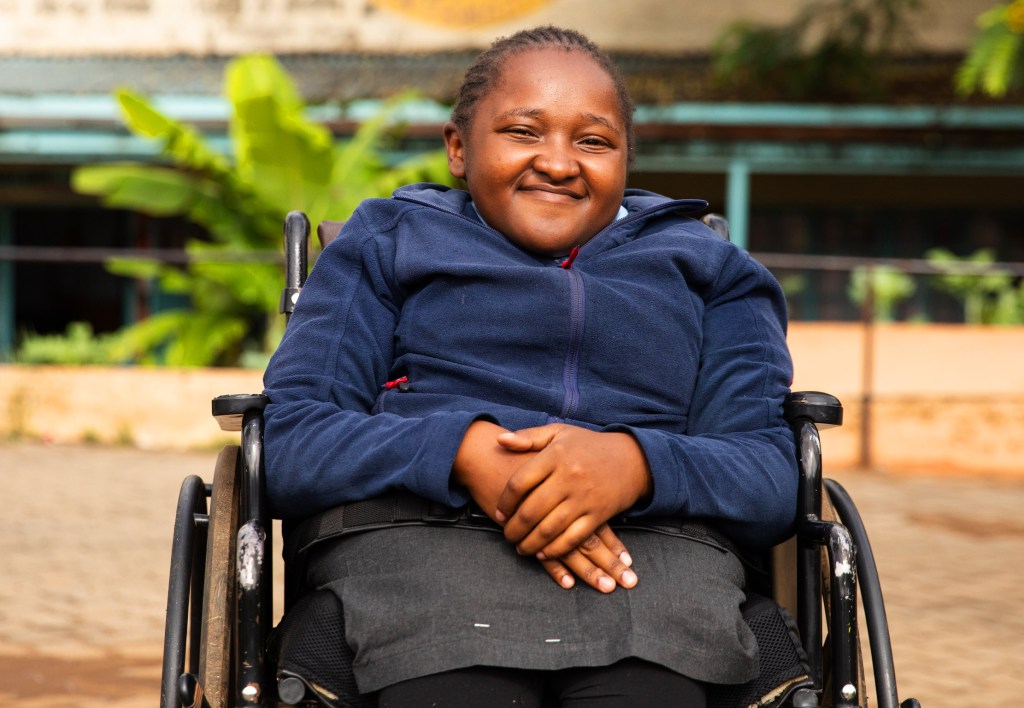
Mercy Muthoni
Across campus, that same sense of ambition is easy to find. Sixteen-year-old Mercy Muthoni lights up when she talks about sports and friendships. She and her best friend spend their time studying, revising and playing games together, small everyday moments that build both knowledge and belonging. But when Mercy speaks about what truly defines Joytown, she points to the adults guiding her journey. ‘I enjoy how our teachers understand us and encourage us to work hard,’ she says. ‘Because they tell us disability is not inability.’
It is a message that echoes far beyond the classroom walls.
A school built on belief
For the school’s leadership, that message is intentional. The principal, Dr Evelyn K Andolo describes Joytown as more than a place of learning. It is a place of transformation: ‘Every child who comes here arrives with potential’,she explains. ‘Our role is to create an environment where that potential can grow academically, socially and personally. We don’t focus on what a child cannot do. We focus on what they can become.’
That philosophy shapes everything from classroom teaching to extracurricular activities. Lessons are adapted, spaces are made accessible and students are encouraged to explore their strengths at their own pace.
Mrs Florence Njeri Kinuthia, the head teacher of Joytown’s Special Primary School echoes this commitment, emphasising the importance of high expectations. ‘Inclusive education is not about lowering standards,’ she says. ‘It’s about removing barriers. When you give children the right support, they rise again and again to meet those expectations.’


Photos clockwise from top left: Mrs Florence Njeri Kinuthia, Joytown’s Special Primary School’s head teacher; Dr Evelyn K Andolo, Joytown’s principal; exterior view of classrooms at Joytown; The Salvation Army’s motto painted on a wall at Joytown.
We don’t focus on what a child cannot do. We focus on what they can become.
At Joytown, support goes beyond academics. Teachers take time to understand each student’s needs, building the trust and confidence that allow learning to flourish. ‘We want our students to leave here not only with knowledge,’ the head teacher adds, ‘but with belief in themselves.’
The challenges, however, are real. Teachers and the principal speak with one voice about the need for more classroom space so pupils can receive the attention they need. There are not enough dormitories or washing facilities and the school hopes to secure further funding in the future, enabling it to support more children and help them reach their true potential.
Overcoming barriers, unlocking potential
For many students, arriving at Joytown marks a turning point. Children with disabilities often face significant barriers to education, from inaccessible infrastructure to social stigma that limits opportunity. Too often, they are excluded or underestimated.
Joytown challenges that reality. By offering accessible facilities, specialised support and a culture of inclusion, the school creates a space where students can thrive. Perhaps most importantly, it challenges perceptions, both within the school and beyond it.
Mercy’s experience reflects that shift. She proudly describes learning to play chess, a game that demands strategy, patience and concentration. It may seem like a small detail, but it is a powerful one. Achievements like these build confidence step by step, reshaping how students see themselves and how others see them too.

A community of support
Friendship is at the heart of daily life at Joytown, in both its primary and secondary schools. Solomon and his best friend study together, revise lessons and help each other through challenges. That sense of mutual support is not incidental; it is part of the school’s culture.
‘We encourage collaboration,’ the principal explains. ‘Students learn from each other, support each other and celebrate each other’s successes. That community is one of our greatest strengths.’
Teachers also play a central role in creating that environment. Their encouragement, patience and belief leave a lasting impression on the students in their care. ‘They understand us,’ Mercy says with a heart full of belief and gratitude.
They are preparing for exams, for careers and for lives in which they can participate fully and confidently. They are future lawyers, professionals, leaders and change-makers.


Sports day at Joytown Primary School
Looking ahead
As the day continues, the movement between classrooms and playgrounds reflects momentum and something deeper. Students at Joytown are not only learning. They are preparing for exams, for careers and for lives in which they can participate fully and confidently. They are future lawyers, professionals, leaders and changemakers.
The principal sees this clearly. ‘Our goal is independence. We want every student to leave here ready to contribute to society, to pursue their dreams and to advocate for themselves and others.’
Back on the sports field, the cheers rise again. A race finishes and students congratulate one another with laughter and pride. For Solomon, Mercy and their classmates, Joytown is more than a school. It is a place where barriers begin to fall away, where belief takes root and where the future is not something distant, but a future they are already creating.
Please click on the link below to watch the accompanying video

You must be logged in to post a comment.